Introduction: The Dawn of a New Era
Let’s cut through the corporate fluff for a second. If you’ve been scrolling through F1 Twitter (or X, whatever you call it these days) and feeling confused about the 2026 rules, you aren’t alone. We aren’t just looking at a few tweaks to the front wing or some fancy new tires. This is a total, ground-up lobotomy of the cars we’ve grown to love—or hate—since 2022. I’ve spent more than fifteen years in and around paddocks, and I can tell you: 2026 is the biggest roll of the dice I’ve ever seen the FIA make.
The two big buzzwords you’ll hear are Sustainability and Agility. But if you look past the PR-friendly talk, there’s a vicious engineering war brewing in the factories at Maranello and Milton Keynes. For the first time, we’re splitting the power 50/50 between the old-school internal combustion engine and pure electric juice. This pivot is so massive it’s actually pulled giants like Audi and Ford into the game. But it’s also making established heavyweights like Mercedes and Red Bull look very, very nervous. This isn’t just about trophies anymore; it’s about who survives the biggest technical reset in the history of Grand Prix racing.
The Heart of the Beast: The 2026 Power Unit Overhaul
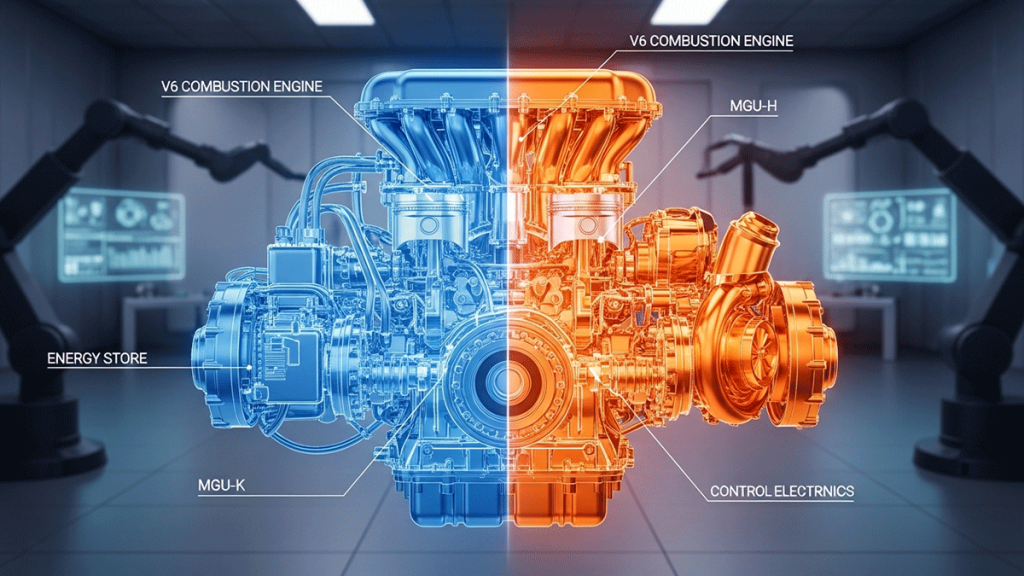
The engine—or the “Power Unit” if you want to be technical—is where the real drama is hiding. For a decade, the MGU-H (the bit that harvests heat) was the genius—and the curse—of F1. It was incredibly clever, but it was so expensive and complicated that it scared away every other car manufacturer in the world. By killing off the MGU-H for 2026, the FIA has simplified things, but they’ve also created a massive hole in the power delivery that teams are scrambling to fill.
The 50/50 Power Split: A Tactical Nightmare
We’re still looking at around 1,000 horsepower, but the way that power hits the rear wheels is changing forever. The internal combustion engine (ICE) is being choked down from 600kW to about 400kW. To make up for that, the Energy Recovery System (ERS) is getting a massive boost to 350kW.
Think about what that does to a driver’s brain. You can’t just floor it and forget it anymore. In 2026, “Battery Management” becomes the most vital skill on the grid. If you burn all your electric energy trying to defend on the first half of a straight, you’re going to “derate”—which is just a fancy word for running out of steam—long before you hit the brakes. You’ll be standing still while everyone else sails past. It’s a high-speed game of poker, and if you miscount your chips, you’re done.
100% Sustainable Fuels: The Invisible War
This is the part nobody talks about enough. F1 is moving to fully sustainable, “drop-in” fuels. This isn’t some weak ethanol blend you find at a local gas station. This is high-level chemistry. Creating a fuel that can survive a turbo-charged V6 at 12,000 RPM while being net-zero is a Herculean task. The relationship between a team and their fuel partner—think Ferrari and Shell—is now the ultimate “hidden” advantage. If your fuel is even 1% less dense than your rival’s, your championship hopes are dead on arrival.
Active Aerodynamics: The "Agile Car" Concept
Let’s talk about the cars themselves. The current generation of F1 cars are often called “boats” by the fans—and honestly, the drivers aren’t fans of how heavy and wide they’ve become either. The 2026 “Agile Car” concept is the FIA’s attempt to fix the bloat. They’re cutting the wheelbase by 200mm and making the cars 100mm narrower.
Moving Wings: X-Mode and Z-Mode
The real “magic” (or chaos) comes from the wings. For the first time ever, we’re going to see Active Aerodynamics on both the front and rear wings.
- Z-Mode: Think of this as “Cornering Mode.” Maximum downforce to stick the car to the track.
- X-Mode: This is “Straight-Line Mode.” The flaps flatten out to kill drag, making the car a rocket on the straights.
Imagine a car that literally changes its shape at 190 mph. It sounds cool, but it’s a terrifying prospect for engineers. If the front and rear wings don’t move in perfect sync, the car’s balance will shift so violently that it’ll be like hitting a patch of ice at 200 mph. One tiny software glitch could be the difference between a podium and a trip to the hospital.
Impact on Team Standings: Winners and Losers
Whenever you throw the rulebook in the trash and start over, the hierarchy gets tossed into a blender. We saw it in 2014 with Mercedes, and we saw it in 2022 with Red Bull. 2026 is the ultimate reset button, and some big names are going to get hurt.
The Red Bull – Ford Gamble
Red Bull is doing something that is either pure genius or total madness. They are building their own engine for the first time in history, with Ford basically providing the checkbook and some battery tech. They have the best facilities in the world, but building an F1 engine from scratch is a mountain that many have failed to climb. If they nail it, Max Verstappen becomes a god. If they fail? We could see the most dominant team of our era sink to the back of the grid. It’s the biggest “What If” in the paddock.
The Audi Entry: The New Powerhouse?
Audi isn’t coming to F1 to lose. They’ve been quietly taking over the Sauber team and building an engine plant in Neuburg that would make NASA jealous. While they are “new” to F1, Audi knows electric power better than almost anyone from their days at Le Mans and Formula E. This 50/50 power split is tailor-made for them. Don’t be shocked if the “Four Rings” are fighting for wins within eighteen months.
Ferrari’s Traditional Engine Pride
At its heart, Ferrari is an engine company. They live for this stuff. The shift to sustainable fuels and high-efficiency combustion plays right into their historical strengths. With Lewis Hamilton now in the fold to provide that elite-level feedback, Ferrari has the best chance they’ve had in twenty years to actually sustain a title fight.
The Human Element: Managing the "Brain-Drain"
I’ve spent a lot of time chatting with drivers about the mental load of these cars. In 2026, it’s going to be brutal. A driver can’t just be a “pure steerer” anymore; they have to be an on-board computer scientist.
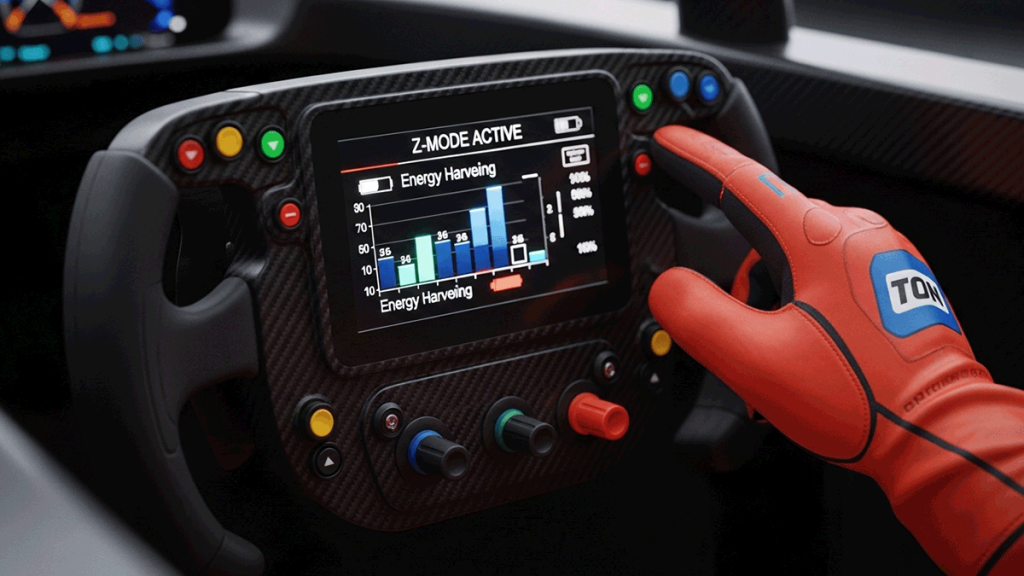
Picture this: You’re defending into the final chicane at Suzuka. You’re checking your mirrors, managing tire temps, and now you have to manually flip your energy harvesting and X-Mode/Z-Mode toggles on the wheel. One wrong click, and you lose 400 horsepower instantly. This is where Experience counts. Veterans like Hamilton and Alonso will probably thrive because they have the “mental bandwidth” to handle the car’s systems while still hitting their marks. The younger kids might find the “Brain-Drain” of 2026 a bit too much to handle at 200 mph.
Technical Deep Dive: Weight and Safety
F1 cars have become heavyweights lately, hitting 798kg. For 2026, the FIA is desperate to cut 30kg. That might not sound like much to you and me, but in F1, 30kg is a lifetime.
The problem is that a lighter car usually means a thinner car. Engineers are having to find ways to keep the chassis strong enough to survive a 200-mph impact while using less carbon fiber. It’s a terrifyingly thin line between being the fastest on the track and being in a dangerous machine.
TABLE 1: 2024 vs 2026 Technical Comparison
| Feature | 2024 (Current) | 2026 (Revolution) | Why it Matters |
|---|---|---|---|
| PU Power Split | 80% Engine / 20% Battery | 50% Engine / 50% Battery | Battery management is now #1 |
| MGU-H | Yes (Complex) | No (Removed) | Louder, simpler engines |
| Wheelbase | 3600mm | 3400mm | Cars will be much "snappier" |
| Active Aero | DRS Only | Front & Rear Moving Flaps | Complete shape-shifting |
Future Outlook: F1 in 2030 and Beyond
2026 isn’t just about the next trophy; it’s about the survival of the sport. If this new formula works, it proves that the roar of an internal combustion engine can exist in a green world. If it fails, F1 might be forced to go fully electric by 2035—and let’s be honest, nobody wants that. The stakes are everything.
Frequently Asked Questions (FAQs)
Basically, it was too expensive and had zero use for normal road cars. Removing it lured Audi and Ford into the sport.
In the corners, probably a little. But on the straights, they will be absolute rockets. Lap times will likely stay about the same.
It’s the setting where the wings flatten out to let the car hit top speed on the straights.
Still around 1,000 HP, just split differently between the gas engine and the battery.
Yes! Without the MGU-H muffling the turbo, we expect a much more aggressive, high-pitched scream.
Audi and Red Bull-Ford are the big ones joining the party.
It’s evolving. It’ll be a mix of the active aero and a "manual override" boost from the battery.
Conclusion: The Ultimate Reset
At the end of the day, Formula 1 is a sport about the pursuit of the impossible. The 2026 rules are a massive gamble, an attempt to keep the soul of racing alive in a carbon-neutral world. For us fans, it means unpredictability. It means seeing who the real geniuses are in the pit lane.
One thing is for sure: the 2026 champion won’t just be the fastest driver. They’ll be the one with the smartest engineers and the best battery management. The era of just “driving fast” is over. The era of the “Thinking Man’s Race Car” has begun.
So, where’s your money? Is this Ferrari’s big comeback, or is Audi about to humiliate the old guard? Let’s hear it in the comments.