Introduction
Every sport has its own improvisations and updates when it comes to rules; in the most sarcastic tone this is one of the things that makes others worldly is the sport of Badminton. All forms of the sport of Badminton including leisure plays at clubs as well as elite competitions held by the Badminton World Federation, the ability to understand the rules of the sport and the unique scoring system expands one’s ability to appreciate the sport at a greater level and understand it more strategically.
The sport of Badminton is one of the most agile and fastest racquet sports. The accomplishments of the sport can be attributed to the scoring system which is a twenty one point rally system that focuses on scoring precision and mental toughness. The scoring is done on an individual basis so every decision counts including a risky smash and a well timed clear which can change the momentum.
Every player has a thought process that determines the level of a player which can range from basic rules and scoring to an advanced explanation of the system. This is the approach that has been used in this document so that every reader can gain the ability to appreciate the sport of Badminton at a greater level and be able to understand it on a more strategic level which is the purpose of this document.
Background / Context: Why the 21-Point System Exists
Badminton did not always use the modern rally scoring format. For decades, the sport used a 15-point service-only scoring system in men’s singles and doubles and an 11-point system in women’s singles. Only the server could win points. This made matches unpredictable and sometimes extremely long.
In 2006, the BWF integrated the 21-point rally scoring into the game to:
- Make matches faster and more exciting
- Create more consistent TV timings
- Increase pressure during every rally
- Reward precision and mental composure
- Standardize scoring across all categories
Today, this scoring system is used in:
- BWF World Tour
- All England Open
- Asian Games
- Commonwealth Games
- Olympics
- National and local tournaments worldwide
Badminton is now even more entertaining, more competitive and a joy to watch.
Main Takeaways: What You Will Study
- The entire system based on scoring 21 points
- How rallies are counted
- How games and matches are structured
- How deuce works at 20–20
- Why 30–29 is the highest possible score
- How service rotation works in singles and doubles
- What “intervals” mean and why they matter
- How scoring affects stamina, footwork, and tactics
- How players manage pressure during critical points
The 21-Point Rally Scoring System
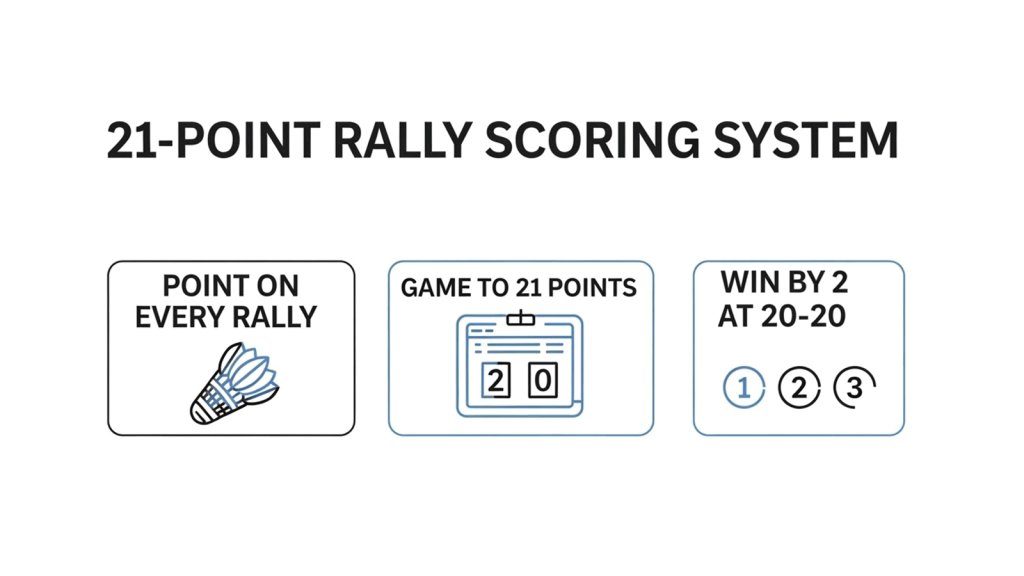
Modern badminton uses rally scoring, meaning:
- Every rally → 1 point
- You do NOT need to be serving to win a point
- First team or player to 21 points wins.
This makes this game really competitive and has element strategy..
How a rally ends:
A player/team wins a rally if the opponent:
- Hits the shuttle out
- Hits the shuttle into the net
- Lets the shuttle land inside their court
- Commits a fault (double-hit, body contact, etc.)
- Misses the shuttle grounded
- Performs an illegal serve
Every rally counts. There are no “free resets.”
Match Structure
A badminton match is played as:
Best of Three Games
- Game 1 → to 21
- Game 2 → to 21
- If tied 1–1, Game 3 decides the winner
This format gives room for tactical adjustments and physical endurance.
What Happens at 20–20 Problems to Solve?
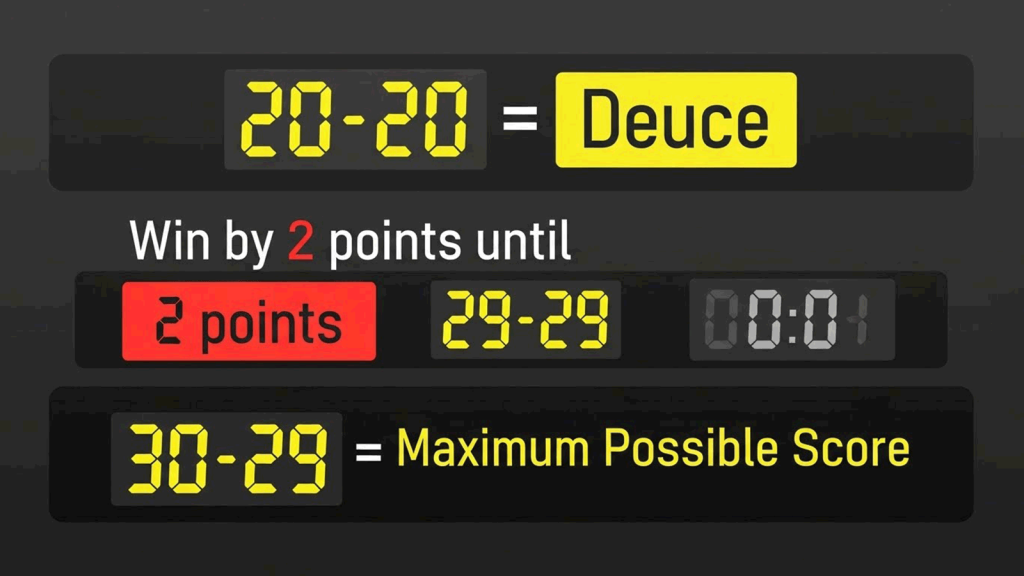
In the case that the score is 20–20, the match continues to be played until he is 21 to 22 is completed to determine the implied winner of the game leading against another player above the other player opponent leads above the 20 score to be equal to 22 to 21 score winner above to be leading at least by two to either of the other two players.
Examples:
- 22–20
- 23–21
- 24–22
However, badminton has a maximum limit.
Maximum Score Allowed: 30–29
If the score reaches 29–29, the next point wins the game.
There is no “win by two” after 29–29.
This rule creates enormous pressure and thrilling finales.
The 11-Point Interval
Each game has an interval at:
11 points
- Players switch sides (only in deciding game)
- 60-second break
- Coaches give tactical instructions
- Players assess shuttle speed and drift
- Players calm nerves and reset footwork patterns
Interval strategy is crucial:
- Attackers use it to adjust smash timing
- Defenders use it to control rally length
Players adapt to drift based on shuttle behavior
Service Rules
Service Rules in Singles

Singles service rotation is actually simple.
Rule: Even-Odd System
- If your score is even, serve from right
- If your score is odd, serve from left
Example:
- Score 6–5 → Player with “6” serves from right
- Score 11–11 → Server with 11 serves from left
The receiver stands in the diagonally opposite court.
Service Rotation in Doubles
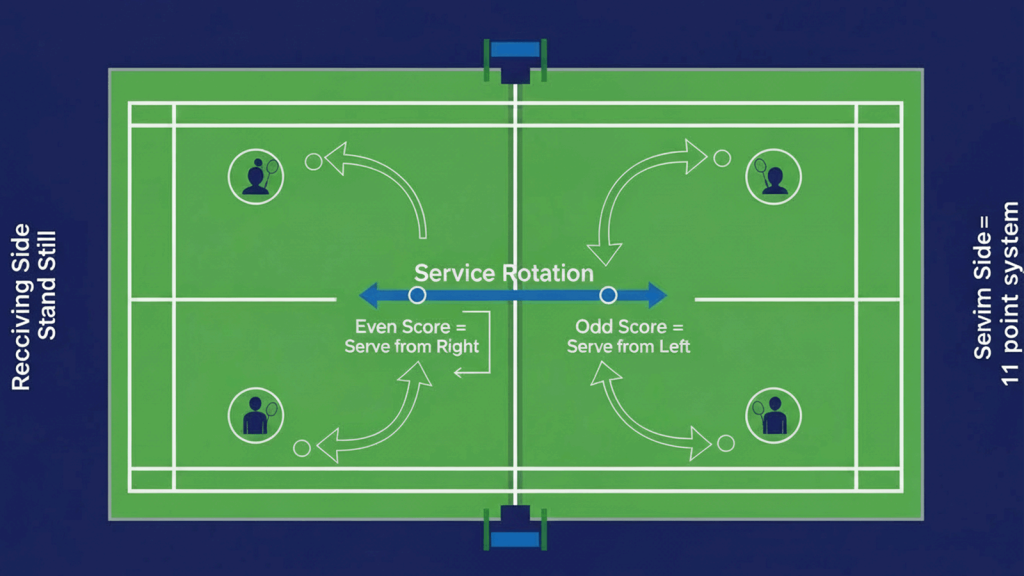
Doubles service is more complex.
Key principles:
- You only change position if your team wins a point on serve
- Receiving team never changes sides until they win the serve
- Position (left/right) depends on the team’s total score
Example:
- Your team has 8 points (even) → server stands right
- Your team has 15 points (odd) → server stands left
Service rotation heavily influences strategy, especially in mixed doubles.
Strategic Impact of the Scoring System
This is where a badminton analyst truly understands the game.
Scoring Pressure Changes Footwork
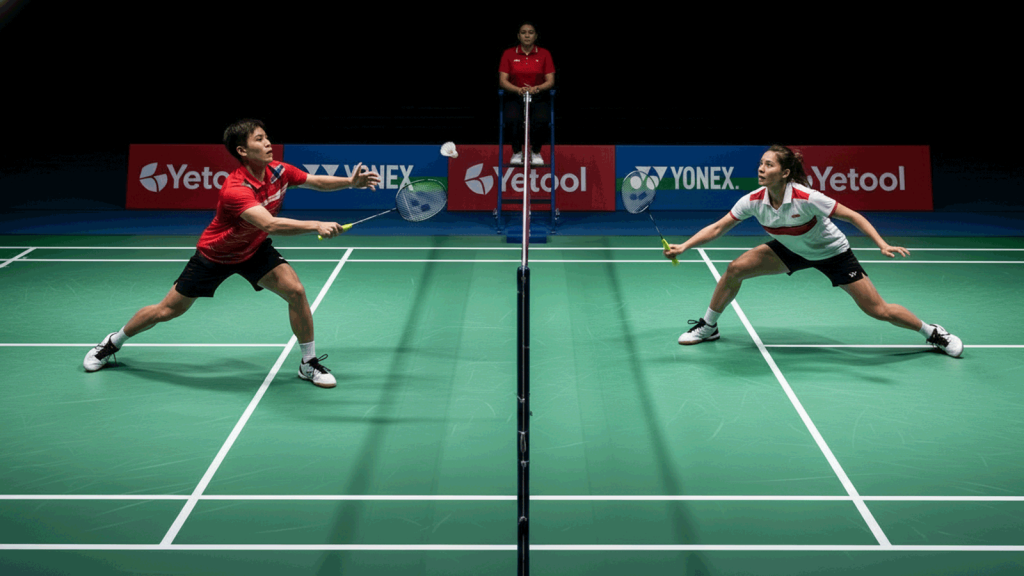
At early scores (1–4, 3–5):
- Players try to build rhythm
- Footwork is relaxed and exploratory
At mid-game (10–12, 12–15):
- Players increase rally aggression
- Push for psychological advantage
- Reduce unforced errors
At late game (17–17, 18–18):
- Footwork intensity increases
- No unnecessary dives
- Controlled recovery to base position
At 19–19:
- Every step becomes calculated
- Players time lunges carefully
Risky cross-court smashes are reduced
Net Dominance at Close Scores
At tight scores, players prefer:
- Tight spinning net shots
- Net kills only when certain
- Minimal risky tumbles
The net becomes the deciding battleground.
Smash Variation Based on Score
Early game:
- Power smashes
- Full-speed attacks
Mid game:
- Mixed smashes
- Drops to disrupt rhythm
Late game:
- Steep half-smashes
- Reduced reckless angles
- Smash only when proper setup exists
Attackers must conserve stamina; defenders must absorb pressure.
Shuttle Speed & Drift Influence Point Control
A fast shuttle favors:
- Flat exchanges
- Countering styles
- Quick net interceptions
A slow shuttle favors:
- Long rallies
- Stamina-based players
- Clear-drop patterns
In big arenas, drift changes:
- Baseline judgement
- Lift length
- Clear height
- Net tape behavior
Players adjust rally patterns accordingly.
Important Badminton Statistics (Explained Simply)
Here are meaningful statistics when analyzing scoring:

Technical Stats
- Smash Speed: Shows attacking ability
- Net Winners: Who dominates frontcourt
- Rally Length: Who controls stamina and tempo
- Unforced Errors: Free points gifted
- Defense-to-Attack Conversion: The ability of the players to transition from defense to offense
Season Stats
- Win Percentage: Consistency in tournaments
- Titles Won: Indicators of dominance
- Performance on Similar Courts: Helps in predicting playing style
- Head-to-Head History: Shows matchup patterns
Even without actual numbers, these stats shape how scoring patterns unfold.
Expert Analysis: Why Scoring Shapes Match Flow
- A 5-point lead feels huge in badminton
- A 2-point lead at 18–16 forces opponent aggression
- The psychological pressure at 20–19 is massive
- Players conserve energy earlier to push hard during last rallies
- Long rallies drain stamina; short rallies increase risk
- Tactical discipline determines success more than raw power
Short rally specialists win quick points.
Rally specialists win late-game wars.
Predictions & Expectations (General)
Without discussing gambling or guaranteed winners, here’s what scoring typically predicts in real matches:
- Fast-paced matches when shuttles are slow
- Long tactical rallies on fast shuttles
- Close games when players have contrasting styles
- One-sided games when one player dominates the net
- Deciding games often go 21–18 to 21–19
- Expect deuce battles in evenly matched contests
Expect physical exhaustion during long rally sequences
Extra Insights
- Scoring rewards players with fewer unforced errors
- Technical players use variations to break scoring runs
- Attackers rely on early dominance; defenders rely on endurance
- In doubles, scoring is heavily influenced by serve quality
- Drift can flip scoring momentum instantly
Interval coaching often decides close games
FAQs
Badminton uses the 21-point rally scoring system in best-of-three games.
Reach 21 points with at least a 2-point lead, or win 30–29.
A player must win by 2 points unless the game reaches 29–29.
No. Every rally result in a point for someone.
The serving side rotates positions based on even/odd scores when they win points.
Conclusion / Final Takeaways
There is a beauty and strategy to the game of badminton and its scoring system. The 21-point rally system applauds the athletes’ mental and tactical perseverance. At every point within the game, the athletes’ put on display their skill and strategy. The scoring system allows the audience and fans to recognize when something is at stake, to see when to win the rally toward the end of the game, to detect when the game rhythm is commencing to gradually tilt in favor of one player and to the fine details of footwork, net control, and shot selection.
Taking into account the intricacies of the game, there is no question that every player, even those at the entry-level competitive tier, must start and master the scoring system to see the brilliance of what professional badminton is. The sport is a masterpiece of speed, intelligence and explosive energy, all within a brilliant framework.
What part of the scoring system do you find most interesting? Share your thoughts below.